




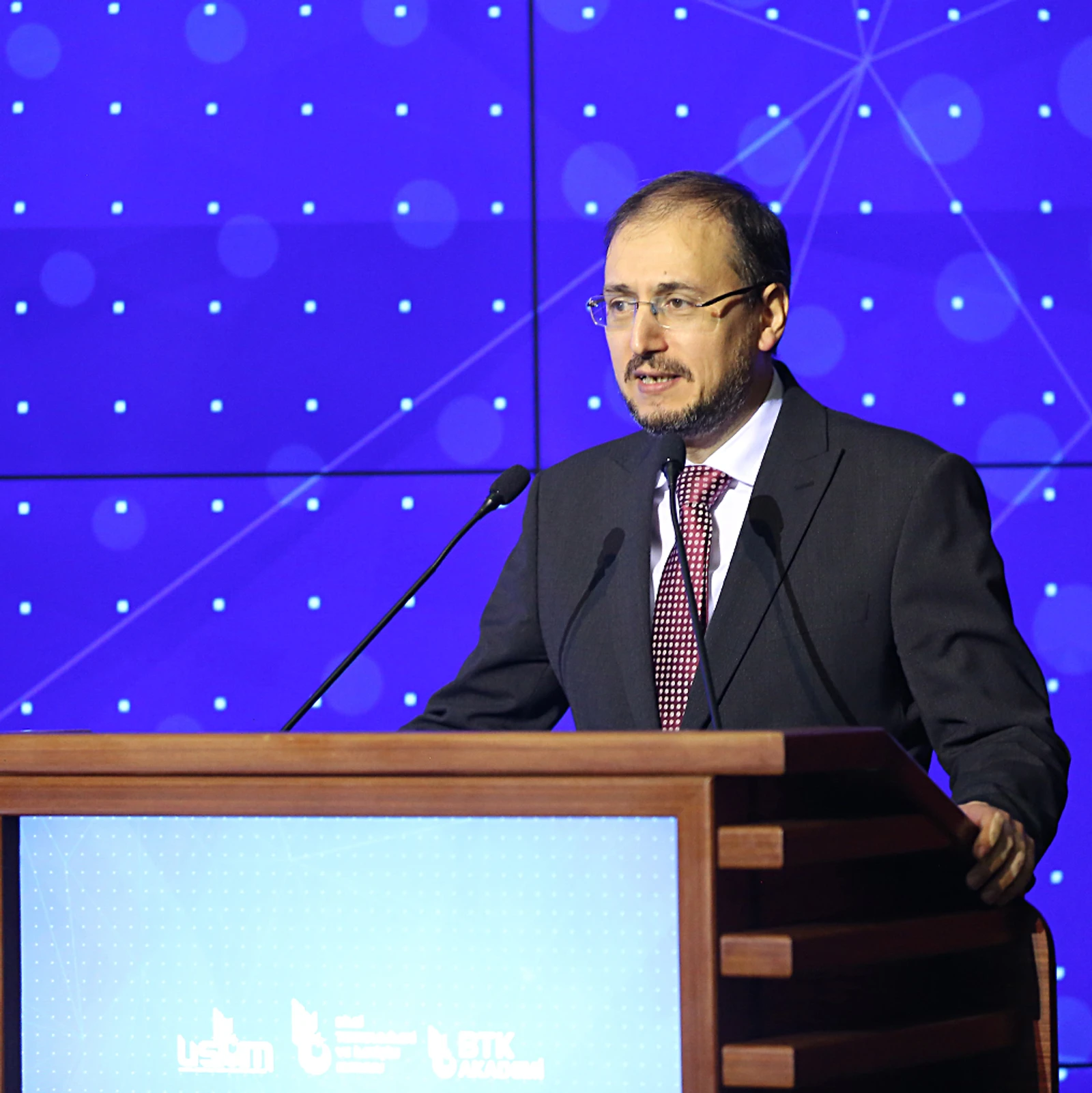
A seminar on Mistakes Made in Cyber Incident Response and Solution Proposals was held at the hosting of the Information Technologies and Communication Authority.
The program, held at the BTK Central Campus, was attended by Ömer Abdullah Karagözoğlu, President of the Information Technologies and Communication Authority, department heads, and numerous USOM and SOME experts.
Emphasizing that the Information Technologies and Communication Authority conducts regulatory and supervisory activities for the electronic communications sector in the country, Karagözoğlu stated, “In addition, in recent years, ensuring national cybersecurity has become one of our Institution's primary focuses. In this context, more resources have been allocated to the ‘National Cyber Incident Response Center’ (USOM), which operates under our Institution, providing new momentum to previous efforts.”
Drawing attention to the importance of the seminar on Mistakes Made in Cyber Incident Response and Solution Proposals, Karagözoğlu said, “USOM continues its activities to develop cybersecurity awareness nationwide, conduct alarm, warning, and notification activities to prevent cyber threats, take control of incidents with on-site response teams in critical situations, and ensure national coordination in cyber incident response. Following the amendments to the ‘Electronic Communications Law No. 5809’ under Law No. 6757, our Institution has been assigned the duties of preventing cyber attacks and ensuring deterrence. Additionally, for the purpose of ensuring national cybersecurity, our Institution has the authority to obtain all kinds of information, documents, records, and data from relevant parties and to utilize IT infrastructures. Furthermore, the same law grants our Institution the authority to impose sanctions on relevant parties, including public institutions and organizations.”
President Karagözoğlu also expressed Turkey's importance in the USOM-SOME context with the following words: “USOM operates in coordination with stakeholders such as public institutions, internet actors, international organizations, judicial authorities, law enforcement, research centers, universities, and the private sector, while also serving as our country’s contact point on the international stage. Notifications from 27 different countries reach USOM, and these are forwarded to the relevant parties to ensure necessary measures are taken. In 2017, cyber security notifications were sent to nearly 1,550 institutions/organizations/businesses. These notifications informed relevant parties about critical vulnerabilities requiring urgent attention in institutions and organizations, as well as vulnerabilities detected in their internet-exposed services, along with the measures to be taken. As of the end of October 2018, nearly 2,700 cyber security notifications have been sent to relevant institutions and organizations. Undoubtedly, in cybersecurity, accessing accurate information and sharing this information promptly, accurately, and with the right person or institution is of great importance. In this regard, ensuring national coordination and cooperation among stakeholders, as well as establishing and developing international collaborations, is an indispensable part of the fight against cyber threats. The number of ‘Cyber Incident Response Teams’ (SOME), which totaled 544 by the end of 2016, has now reached 1,077. Under the studies conducted by USOM, the SIP (SOME Communication Platform) Project, which enables secure and rapid sharing of cyber threats, vulnerabilities, and attacks between USOM and SOMEs, was launched in 2017 and has been actively used since. Currently, 2,800 registered cybersecurity experts are using the SIP system. It is clear that one of the most important resources for ensuring national cybersecurity is qualified human resources. In this framework, we must take the necessary steps swiftly and train qualified experts to close the cybersecurity specialist gap in our country.”
Karagözoğlu listed the services provided by BTK to USOM as follows: “As BTK-USOM, we are also conducting significant studies in this area and contributing to meeting the need for cybersecurity experts in our country. The SIBER YILDIZ competition we organize, trainings for SOMEs from various critical sectors such as health and energy, and periodic consultation meetings to enhance USOM-SOME coordination are among our efforts in this regard. Inter-institutional cooperation, coordination, and information flow are the most important factors in combating cyber attacks. In this sense, I would like to emphasize once again the vital importance of communication between USOM and our SOMEs. The trainings we organize for SOMEs and the consultation meetings held to increase USOM-SOME coordination also provide significant contributions in this regard.”